



Several Muslim leaders and thinkers having insight into the Muslim-Hindu situation proposed the separation of Muslim India.
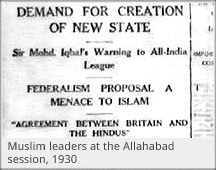
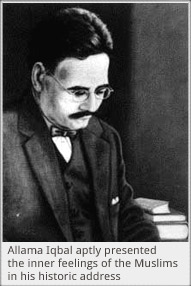
However, Allama Muhammad Iqbal gave the most lucid explanation of the inner feelings of Muslim community in his presidential address to the All India Muslim League at Allahabad in 1930. Allama Muhammad Iqbal was a poet, philosopher and thinker who had gained countrywide fame and recognition by 1930.
Political events had taken an ominous turn. There was a two-pronged attack on the Muslim interests. On one hand, the Hindus offered a tough opposition by proposing the Nehru Report as the ultimate constitution for India. On the other, the British government in India had totally ignored the Muslim demands in the Simon Commission report.
 At this critical juncture, Iqbal realized that the peculiar problems of the Muslims in North-West India could only be understood by people belonging to this region and that in order to survive they would have to chalk out their own line of action.
In his address, Allama Iqbal explained that Islam was the major formative factor in the life history of Indian Muslims. It furnished those basic emotions and loyalties, which gradually unify scattered individuals and groups and finally transform them into a well-defined people, possessing a moral consciousness of their own.
He defined the Muslims of India as a nation and suggested that there could be no possibility of peace in the country unless and until they were recognized as a nation. He claimed that the only way for the Muslims and Hindus to prosper in accordance with their respective cultural values was under a federal system where Muslim majority units were given the same privileges that were to be given to the Hindu majority units.
 As a permanent solution to the Muslim-Hindu problem, Iqbal proposed that Punjab, North West Frontier Province, Baluchistan and Sindh should be converted into one province. He declared that the northwestern part of the country was destined to unite as a self-governed unit, within the British Empire or without it. This, he suggested, was the only way to do away with communal riots and bring peace in the Sub-continent.
The greatest historical significance of Allama Iqbal’s Allahabad address was that it cleared all political confusion from the minds of the Muslims, thus enabling them to determine their new destination.
The national spirit that Iqbal fused amongst the Muslims of India later on developed into the ideological basis of Pakistan.
This article was last updated on Sunday, June 01, 2003